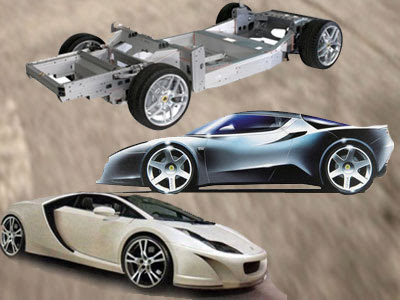
Showing posts with label prototype. Show all posts

Sunday, April 22, 2012

1948 Tasco prototype, first car with t tops... which the designer patented, and sued GM for using on the 68 Vette without licensing


 a Derham-bodied prototype for a post-WWII American sports car and featured airplane inspired controls. It is a one-off vehicle designed by Gordon Buehrig. it is the first car in the world with a T-top roof. Buehrig patented the idea and sued GM when they used it on the 1968 Corvette. He received very little for his patent. This unique car includes fiberglass steerable front fenders. Mr. Richie Clyne donated this car to the Auburn Cord Duesenberg Automobile Museum.

The company name 'Tasco' is an abbreviation for 'The American Sportscar Company.' This mostly-aluminum prototype was created to inspire a contract with the Beech Aircraft Company for production of an aviation-styled automobile. from http://www.conceptcarz.com/events/eventVehicle.aspx?carID=15182&eventID=200&catID=1551

Tuesday, February 14, 2012

the Seattlite, and other cool stuff from Karamelocycles.blogspot.com


the above is a cool shot if the interior of the Alexander Brothers "Deora" custom dodge van


the above is the prototype Mustang if I remember correctly

 Above is a copy of the Davis car brochure

tow a motorcycle with a Fiat... cool!


 these shots are from the 1951 Buick LeSabre prototype that was in the GM styling cross country tours and car shows of the Futureliner and Autoramas. Above is a very cool design around the steering wheel, below are real cool looking gauges
all from http://karamelocycles.blogspot.com/

Monday, January 16, 2012

Zora Duntov and the Chevrolet skunkworks built 40 special 1959 Biscaynes, Police specials... Zora used his as the test mule


348/350 HP law-enforcement pursuit vehicles, featured in Motor Trend (Dec. 58) and Muscle Car Review (Feb 2008)

They were faster than that years best factory Ferrari according to Musclecar Review.. well, Zora's was the test mule and got the special treatment you'd expect the boss and leader of the Chevy racing program to get... it was capable of 135mph

the photos are from this auction listing, that states it's thought to be the last one left, and was originally delivered to the Oregon St Police http://mecum.com/auctions/lot_detail.cfm?LOT_ID=CA0810-96579

Thursday, November 19, 2009

2011 Lotus Esprit Sports Car will be a wholly different Beast powered by a 4.4 liter V8 engine

2011 Lotus Esprit Sports Car

The guys over at AutoCar have caught the upcoming Lotus Esprit testing in cold-snowy weather of Sweden. After running some DVLA records and matching the license plate, AutoCar has learned that the prototype is powered by a 4.4 liter V8 engine. Lotus sources have previously said that BMW may be the supplier for Lotus’ 2011 Esprit.It’s possible that the new Lotus Esprit will carry the 4.4 liter twin-turbo V8 engine from the new BMW X6, but will most likely be tuned to develop 500 horsepower.Currently the 4.4 liter twin-turbo from V8 produces 400 horsepower. The engine is also expected to be used in other BMW models including the X5 and the 7-Series. Lotus engineers will most probably re-work the engine management to reach numbers closer the Nissan GT-R and the Porsche 911 Turbo.
According to Lotus insiders, the next-gen Elise will arrive sometime in early 2011 followed by an all-new V8-powered Esprit in 2012...............................2011 Lotus Esprit Sports Car
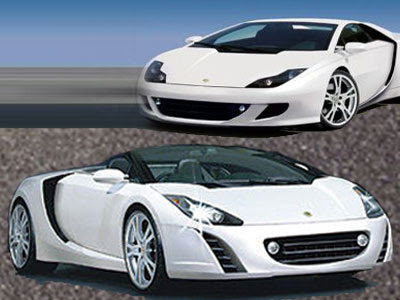
The 2011 Elise will likely be built upon an evolved version of the current model’s extruded-aluminium underpinnings and continue the same formula that’s made the pint-sized sportscar a track day fave, but the Esprit will be a wholly different beast.
While the new Elise is all but locked in, the Esprit project is very much dependent on whether Lotus can sell enough Evoras to fund it. The timeline for the Esprit is also at the mercy of the global economic situation, with Lotus likely to delay the Esprit and forge ahead with a far less costly drop-top Evora if the recession persists much longer.
If it launches on time, the Esprit could be Lotus’ best hope of gaining a much larger share of the sports car market.
There are speculations stating that the 500bhp V10 powerplant can be the source of power for the Lotus Esprit, which will be released in 2012...............................2011 Lotus Esprit Sports Car

The engine is currently being used in the Lexus LF-A, a car that has not yet been launched itself. Being connected with the Japanese carmaker Toyota, Lotus has access to its entire range of parts and components, as well as powerplants from the Lexus line. This points to the likelihood of an Esprit flagship, costing more than ?100,000, equipped with the compact 8500rpm V10 unit (to rival the Lamborghini Gallardo), including a less expensive variant equipped with the 5-liter, 417bhp V8 from the Lexus IS-F and an entry-level model coming with a Lotus-tuned direct-injection Toyota V6 unit that can come up with 300bhp.
Although a V8 or a V10 unit would definitely boost the profile of Lotus, there is also a possibility of an Eco Esprit. Lotus is moving forwards with more efficient products with lightweight engineering and its keen interest in alternative fuels and hybrid solutions. This is also underline by its partnership with the electric car manufacturer Tesla...............................2011 Lotus Esprit Sports Car
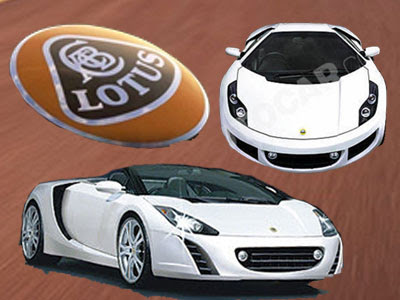
The Esprit was inspired by the larger bonded and extruded aluminum chassis of the recently launched Evora, the rear section of which have been developed to accommodate both transversely and longitudinally fitted engines. Although the Lotus has shown that it can develop a new model in a short time (the Evora, for example, was developed in 27 months), the work on the Esprit will only reach its maximum when the Evora is being swept out of showrooms in the UK, Europe and US. It is the Malaysians who are funding the Evora project, with the persuasion of Lotus CEO Mike Kimberley.

Thursday, November 5, 2009

Lamborghini "Concept S" Supersportscar, The "Concept S" is equipped with a powerful V10 engine.

Lamborghini "Concept S"

The Lamborghini "Concept S" design study premiered at this year's Geneva Motorshow as an extreme and spectacular expression of the Lamborghini brand.
The House of the Raging Bull has shown the first driveable prototype of the Lamborghini "Concept S" at the Monterey Concorso Italiano and at the Pebble Beach Concours d'Elegance in the USA.It was created at the Centro Stile Lamborghini in Sant'Agata Bolognese by Luc Donckerwolke, who drew inspiration from the classic single-seater racing cars of the past.The astonishing amount of public interest at the Geneva Motor Show prompted the decision to build a driveable prototype in order to further gauge potential customer demand.
The driveable "Concept S" prototype has only changed slightly compared to the original design study. For example, the so-called "saute-vent" windscreens were re-designed for homologation reasons. The look of the car results even more extreme than the original.
"The "Concept S" represents everything that Lamborghini stands for. It is extreme, uncompromising and Italian," commented Stephan Winkelmann, President and CEO of Automobili Lamborghini. "A production decision has not yet been made, though we were encouraged by the positive response to the driveable prototype at both Monterey and Pebble Beach." ..............................Lamborghini "Concept S"

The aerodynamics of the "Concept S" have been optimised thanks to front and rear spoilers and a large rear diffuser. An electronically controlled, retractable central rear view mirror allows the driver to see what is happening behind the car - when required!
The House of the Raging Bull has shown the first driveable prototype of the Lamborghini "Concept S" at the Monterey Concorso Italiano and at the Pebble Beach Concours d'Elegance in the USA.
Classic single-seaters did not have a traditional windscreen, but utilised the „saute-vent" in order to direct air over the head of the driver. In the "Concept S", these devices divide the cabin into two distinct compartments, giving the car an aggressive and futuristic look.
They also create a space between them that acts as an additional air inlet for the engine, which is positioned behind the seats. And like the Gallardo, which serves as the basis for this stunning supersportscar, the "Concept S" is equipped with a powerful V10 engine. ..............................Lamborghini "Concept S"

The Lamborghini "Concept S" design study premiered at this year's Geneva Motorshow as an extreme and spectacular expression of the Lamborghini brand. It was created at the Centro Stile Lamborghini in Sant'Agata Bolognese by Luc Donckerwolke, who drew inspiration from the classic single-seater racing cars of the past.
The driveable "Concept S" prototype has only changed slightly compared to the original design study. For example, the so-called "saute-vent" windscreens were re-designed for homologation reasons. The look of the car results even more extreme than the original.

Thursday, October 15, 2009

Yamaha OX99-11 Supercar 3498 cc V12


Yamaha OX99-11 Supercar 3498 cc V12

Yamaha initially approached a German company to come up with some designs for the supercar. However Yamaha dismissed the proposals as they were considered to similar to existing supercars. IAD were at this point hired to continue work on the project. In 1992 IAD came with an initial version of the OX99-11.
The Yamaha OX99-11 was a supspercar designed by IAD, an English engineering consultancy, and Yamaha subsidiary Yilon Technology.
While the Yamaha OX99-11 was originally slated to appear in 1994, the roots of the OX99-11 project began in 1989 when Yamaha began competing in Formula One, later this spawned the desire to create a supercar based on Formula One technology.
Despite the fact the Formula One team was less than competitive, a new engine called the OX99 appeared in 1991, helping to give the new car a name.
Yamaha OX99-11 Supercar 3498 cc V12

The new car featured an unusual and somewhat ugly design, features like the prominent front spoiler, tandem seating, cockpit shaped roof and protruding engine scoop stood out from other vehicles. Other features of the car which were rather extreme included the carbon fiber chassis and OX99 engine which were borrowed from the F1 car.
Budget disagreements meant the Yamaha OX99-11 project was taken from IAD and handed over to Ypsilon Technology, who were given 6 months to finish the project. A further blow to the project was came in the form of a financial crisis which hit Japan and it was decided that there wouldn't be enough buyers capable of handing over the vast sums of money needed to buy the car. In 1994 the Yamaha OX99-11 project was axed. By this point only 3 prototypes had been constructed.