Thursday, October 8, 2009

Carrera Facelift Porsche 911 Sports Car.


Carrera Facelift Porsche 911 Sports Car.

MANSORY Switzerland The High-quality refining programme for the new Porsche 911.
The company Mansory is situated in Bavaria and one of the top addresses for refining premium sports cars. Whether Bentley, Rolls-Royce, McLaren, Ferrari or Porsche – the refining specialist shows its technical talent for every automobile. The subsidiary company Mansory Switzerland AG, the in-house expert for Porsche cars, presents a comprehensive tuning programme for the model 911 from the recently revived Porsche Type 997 series at the Geneva Auto Salon 2009. This tuning programme mainly focuses on improvements concerning the aerodynamics, engine performance and handling of this sports car icon.
When developing the 911-programme, the Mansory engineers attached great importance to an individual design, but also aerodynamic efficiency. In order to save weight and guarantee highest quality standards, the body components are made of composite also, parts of the serial auto body are made of this resilient and inherently stable material. The core part of the body kit is a lift-reducing front mount in a sportive-dynamic look. In connection with the hood, the front apron offers various design possibilities. On the one hand, it forms the perfect symbiosis with the serial hood, as an especially designed inlay allows a seamless junction. And on the other hand, the apron can be combined with the Mansory carbon hood whose striking side beads demonstrate individuality and underline the sportive character of the modification. The rear apron is not less impressive: it accommodates the new four-pipe exhaust system and therefore renders a harmonic rear finish. The visual perfection of the aerodynamics pack is accomplished with the side skirts which also fulfil functional tasks. They significantly calm the air flow between both axles.
The power engines also profit from the comprehensive changes of the 911 engine range. But here, the engineers do not perform any excessive open-heart surgery, but only replace existing parts by modified proprietary developments. A new sport air filter and a new exhaust system come into operation. Especially the exhaust system renders an optimised exhaust gas flow. This enable the 911 to accelerate from 0 to 100 km/h even faster than the serial versions.
But the special highlight of the exhaust system is the integrated throttle system which - if desired - can also be operated by remote control and allows changing the sound scenery.
The refining specialist developed a forged wheel with an exclusive design which was tailor-made for Porsche requirements. The one-piece wheel with five double spokes measures 8.5 x 20 inches at the front and 12 x 20 inches the back. Not only its sportive look, but also its excellent manufacture makes it so impressive. The reduction of unsprung masses by the exceptional and elaborate production technology does not only lead to a shorter braking distance, but also improves the acceleration and the handling of the car. For best possible grip, Mansory uses Michelin Pilot Sport wheels sized 245/30 at the front and 325/25 at the rear. Moreover, the newly developed running gear which lowers the car´s centre of gravity by 30 millimetres also sets sportive accents.


Wednesday, October 7, 2009

Audi R15 Tdi Diesel-Engined Sportscar Petit Le Mans Race

New Sports Audi R15 Tdi Petit Le Mans Race

Britain’s Allan McNish (pictured) came tantalisingly close to achieving his fifth Petit Le Mans race victory at Road Atlanta on Saturday (26 Sep) and maintaining Audi’s 100% winning record in the annual American sportscar endurance race since the German manufacturer’s debut in 2000.
The Dumfries-born double Le Mans 24 Hour race winner and Italian co-driver Dindo Capello led for the opening 4hrs before the Scotsman suffered two spins and dropped to third place on the treacherously wet and slippery track in Georgia - moments before the race went in to a Safety Car period and was ultimately stopped with almost five hours run.
After a further delay of almost four hours and near constant heavy rain, organisers decided not to re-start the event which in any case was limited to 10 hours or 1,000-miles, leaving the McNish/Capello diesel-engined Audi R15 TDI classified third, a mere 3.465secs behind the winning Peugeot (Franck Montagny/Stephane Sarrazin).
The McNish/Capello Audi had started from third place on the 27-car grid but McNish swept in to the lead on the opening lap. The “sister” R15 TDI of Lucas Luhr/Marco Werner began from fourth place, a position the German duo were classified in, one lap down on the top-three, when the race was declared over. Meanwhile the McNish/Capello Audi won the efficiency award “Michelin GreenX Challenge” – a trophy awarded to the most environmentally friendly car.
Audi unexpectedly contested a third race of the year to collect further race information about its new sports-prototype in preparation for the Le Mans 24 Hours next June.

Sky Concept The Mazda 2010 Featuring the next-generation Mazda SKY concept powertrain technologies and comprehensive advancements in weight reduction

Sky Concept The Mazda 2010

The next-generation compact concept car imbued with Mazda’s fun-to-drive character, will make its Japanese debut at the Tokyo show The Mazda Kiyora. Featuring the next-generation Mazda SKY concept powertrain technologies and comprehensive advancements in weight reduction, the Kiyora achieves outstanding fuel economy, estimated to be 3.1 l/100 km (under Japan’s 10-15 mode test cycle).
To make its Japan debut * Mazda Kiyora concept car, which achieves 3.1 l/100 km fuel economy.
Mazda’s theme for the 2009 Tokyo Motor Show is “The Mazda SKY concept – Providing driving pleasure and environmental and safety features for all customers!” Under the headings of “Today,” “Tomorrow” and “The Future,” Mazda will display advanced technologies designed to improve the average fuel economy of Mazda vehicles sold globally by 30 percent before 2015 compared to 2008 levels. This is one of the goals of Mazda’s long-term vision for technology development, Sustainable Zoom-Zoom.
The SKY concept embodies Mazda’s desire to ensure an “everlasting blue sky” under which drivers will always be able to enjoy the pleasure of driving afforded by owning a Mazda. The concept also reflects the “sky’s the limit” aspirations of Mazda’s engineers as they employ unconventional thinking to achieve optimal performance in every vehicle that bears the Mazda nameplate.
Mazda is committed to significantly improving the core aspects of its vehicles that affect performance – engines, transmissions, and lighter vehicle weight – in order to achieve elevated driving pleasure together with outstanding environmental and safety features. The Mazda SKY concept defines Mazda’s approach to developing next-generation powertrains that will significantly improve the eco-friendliness and dynamic performance of all Mazda vehicles.
Based on the SKY concept, Mazda’s “Technologies for Tomorrow” display at this year’s Tokyo Motor Show will include the next-generation direct-injection petrol Mazda SKY-G engine and the Mazda SKY-D clean diesel engine. Both offer improved eco-friendliness and torque thanks to optimised combustion efficiency. Mazda will also reveal its first next-generation automatic transmission, the Mazda SKY-Drive, which offers first-rate fuel economy and a direct driving performance feel
Alongside the SKY concept exhibits, Mazda will also feature a “Today’s Technologies” exhibit that includes i-stop, a unique idling stop system that was introduced with the all-new Mazda3 (Axela in Japan). “Future Technologies” will showcase the advanced Mazda Premacy Hydrogen RE Hybrid, with its hydrogen-powered rotary engine, and various vehicle technologies under development as part of Mazda’s drive to realise an accident-free and safe motorised society.

The E-Class Coupe Mercedes E 500 is The V8 Engine


V8 Engine The Mercedes E 500 E-Class Coupe

The Mercedes E 500 E-Class Coupe has released by German tuner Carlsson.
The new kit includes a new front lip spoiler, new side sills and a new rear lip with integrated exhaust system and air diffuser.
The kit is completDuned by the 20-inch 1/5 REVO light alloy wheels wrapped in Dunlop tyres measuring 235/30. Under the hood, the V8 engine of the E500 Coupe was boosted from 388 hp and 530 Nm of torque to 435 hp and a maximum torque of 600 Nm. Also, a new coilover suspension and sport springs with a lowering range of 30 millimetres have been added for better handling. Inside, we find new accessories such as a gearstick in leather/ultra suede, a leather/ultra suede steering wheel cover, Carlsson aluminium pedals covers and new floor mats with the Carlsson logo.
For the new E-class Coupé (Type C 207) Carlsson introduces an entire individualisation kit on the occasion of the Frankfurt Motor Show.The sport rear exhaust silencer is made of stainless steel and with its two oval end pipes it guarantees a sportive sound and an extra output of eleven hp. The sport centre exhaust silencer and a sport air filter effectively complete the engine kit.
Carlsson provides optimal road holding with a coilover suspension which offers a stepless adjustment for damping and vehicle height. Carlsson sport springs with a lowering range of 30 millimetres are also available.
Carlsson offers the light alloy rim 1/5 REVO in modern two-colour varnish and in the size 8.5 x 20 inches at the front- and rear axle with Dunlop tyres measuring 235/30. The visual kit includes the Carlsson front spoiler. The Carlsson front spoiler lip RS is delivered optionally in real carbon. The flow line optimised Carlsson rear spoiler concludes the optical refinement.
Carlsson offers a broad range of accessories: The gearstick is available in leather/ultra suede, for the steering wheel, a leather/ultra suede cover has been engineered and for the pedals, sporty Carlsson aluminium covers. Moreover, the programme also includes floor mats with an illuminated Carlsson logo; especially at night times, they render an impressive ambience without blinding the passengers.

Toyota FT-86 Concept definitely looks cool.Toyota sports car concept


Toyota FT-86 Concept definitely looks cool.

The concept car Toyota FT-86 (that’s hachi roku in Japanese) goes back to the fundamental qualities of the classic sports car with its rear-wheel drive configuration, compact dimensions, low centre of gravity and lightweight construction. Under the bonnet there is a 2.0-litre boxer engine that is strong on both performance and environmental quality
Great to own and fun-to-drive: those are the guiding principles behind a new Toyota sports car concept that will break cover for the first time at the Tokyo motor show later this month.
The show car’s bodywork is finished in Flash Red, an eye-catching shade that contains a hint of blue. Inside, the cabin design further expresses the car’s classic sporting qualities with many of the structural elements left uncovered.

Sunday, October 4, 2009

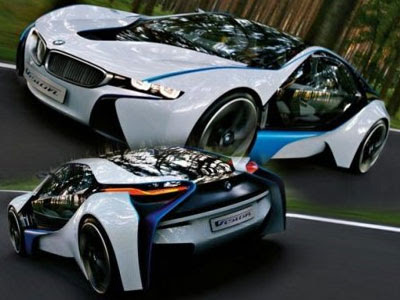
2010 BMW EfficientDynamics Sport Diesel Hybrid Concept Car

2010 BMW EfficientDynamics Sport Diesel Hybrid Concept Car

EfficientDynamics concept
, a world premiere which will be held in September at the Frankfurt Auto Show. Spectacular quadruple-door coupe with the “guillotine” represents the fusion of sportiness and eco-friendliness. Its hybrid power unit consists of a three-cylinder turbo diesel and two electric motors with total capacity 356 hp.
Coupe can move and electric traction, although in this case, the mileage is limited to 50 kilometers. With all three engines accelerate to 100 km / h takes just 4.8 seconds and a top speed of 250 km / h, while fuel consumption does not exceed 3,76 l/100 km.

Saturday, October 3, 2009

The Veyron Bugatti Concept Sport Car by Hartmut Warkuss


Veyron Bugatti Concept Sport Car

The Veyron was designed by Hartmut Warkuss of Volkswagen rather than Giorgetto Giugiaro of ItalDesign who had handled the three prior Bugatti concepts.
Development continued throughout 2001 and the EB 16/4 Veyron was promoted to "advanced concept" status. In late 2001 Bugatti announced that the car, officially called the Bugatti Veyron 16.4 , would go into production in 2003. The car experienced significant problems, however. High-speed stability was difficult, with one prototype destroyed in a crash and another spun out during a press demonstration at the Monterey Historics event in Mazda Raceway at Laguna Seca . Production of the Veyron was delayed indefinitely.
After the release of the car, it has become known that while each Veyron is being sold for £840,000, the production costs of the car are approximately £5 million per vehicle. As Bugatti, and therefore Volkswagen, are making such a huge loss, it has been likened by influential journalist Jeremy Clarkson to Concorde ; both are largely impractical experiments in technology and ground-breaking performance created just to prove that it could be done. A car the like of the Bugatti Veyron may not be seen in production again for some time to come, if at all.
The Veyron features a W16 engine —16 cylinders in 4 banks of 4 cylinders, or the equivalent of two narrow-angle V8 engines mated in a vee configuration. Each cylinder has 4 valves , for a total of 64, but the narrow V8 configuration allows two camshafts to drive two banks of cylinders so only 4 camshafts are needed. The engine is fed by four turbochargers , and it displaces 8.0 L (7,993 cm³/488 in³) with a square 86 by 86 mm bore and stroke.
The Veyron's 16-cylinder engine is based on the innovative "W" design introduced in the 2003 Volkswagen Passat. The Veyron's version features two 90-degree V8s offset by 15 degrees. The offset allows each cylinder to be placed close to its neighbor, which reduces the total size of the massive 8.0-liter engine. A Formula 1?style dry-sump lubrication system keeps the engine moving smoothly. It's easier to spin many small turbochargers than one or two large ones, so Bugatti employs four turbos to reduce boost lag. The strategy works: The engine creates 922 lb.-ft. of torque at only 2,200 rpm.
Putting this power to the ground is a dual-clutch DSG computer-controlled manual transmission with 7 gear ratios via shifter paddles behind the steering wheel. Or it can be driven by full automatic transmission. The Veyron also features full-time all wheel drive , necessary given the output of the engine. It uses special Michelin PAX System run-flat tires, which had to be designed specifically for the Veyron, and which are capable of running at 402 km/h (253 mph).
The car's wheelbase is 2700 mm (106.3 in). Overall length is 4466 mm (175.8 in). It measures 1998 mm (78.7 in) wide and 1206 mm (47.5 in) tall. Curb weight is expected to reach 4300 lb (1950 kg) with a power to weight ratio of 513.3 hp per ton (metric) or 4.36 lb/hp (SAE).The Bugatti Veyron has a total of 10 radiators .